
A letter to the Riviera Maya I met in 2010

Corals that are gone, sargassum that persists, and why I keep designing journeys
I travelled with my father to the Riviera Maya in 2010 to complete our diving certification. We immersed ourselves in what was known as the second largest barrier reef in the world. Four unforgettable dives: we swam alongside giant turtles, crossed natural tunnels formed by coral, and, while parasailing, saw from the air the immensity of the Mexican Caribbean, with its turquoise, cobalt blue and emerald green stripes.
During four days of training, I paid 400 dollars to learn how to breathe underwater in front of such wonder. The phrase —“second largest barrier reef in the world”— I had found the night before on Wikipedia, thrilled to have such a treasure just nine hours from Buenos Aires. It felt like a privilege to see it, to have it here in the Americas.
Tour operators preferred other adjectives: “crystalline waters”, “unique biodiversity”, “unforgettable experience”.
I learned that nitrogen can kill you if you ascend too quickly, that moray eels may mistake your finger for a fish, that you should never touch coral. Nobody mentioned that the coral we were told not to touch was already dying. Silence was part of the product. We had paid for a dream, not for an ecology lesson.
Cozumel, with its famous coral walls, remained pending. But even then we knew the reefs were in danger.
The return and the invisible brigades
I went back in 2017, this time to Tulum, though I didn’t dive. Armed with Google Maps and determined to avoid crowds, I found a beach labelled by algorithms as a “hidden gem.” At six in the morning, waiting for the sunrise, I discovered another scene: cleaning brigades.
Four men with rakes and a pickup truck collected mountains of algae before the first tourists arrived. They worked silently, efficiently, invisibly. When I asked, one said: “It’s temporary, miss. Just currents.” But his eyes said otherwise. It was 2017 and sargassum had been arriving for six years. How long does “temporary” last when no one dares to name it?
Living in Mexico, I learned that sargassum was no longer a seasonal inconvenience but a crisis shaping every conversation about Caribbean tourism. The question was no longer if it would come, but how to hide it.
The new Caribbean vocabulary
I learned a coded language of the industry:
- “Variable natural conditions” (there is sargassum).
- “Authentic Caribbean experience” (you’ll see the reality outside postcards).
- “Coastal renewal season” (do not come these months).
- And the most perverse: “Opportunity to discover other attractions.” As if ecological collapse were an invitation to buy more tours.
What caught my attention: the conversation always focused on economic impact. Almost never on environmental effects. And rarely on the reef itself.
The sargassum belt
Since 2011, beaches once ranked among the cleanest in the world have received tons of floating algae called sargassum. What first seemed like an anomaly became an annual pattern, with increasingly severe consequences.
Sargassum —Sargassum natans and Sargassum fluitans— has always existed, drifting in the North Atlantic as part of a healthy ecosystem. The problem is scale: excess nutrients from the Amazon and Orinoco, global warming, altered currents. All combined to form the Great Atlantic Sargassum Belt, a strip of more than 8,000 kilometres of algae —the size of 800 Buenos Aires— that drifts every year from Africa to the Caribbean.
It doesn’t just ruin postcards. It blocks sunlight corals need, releases toxic gases as it decomposes, alters water pH, and fosters bacteria competing with reefs. All this while the Mesoamerican Barrier Reef already suffers bleaching, acidification, and pollution.
In Martinique, a school was forced to close because of the gases. In Barbados, hotel occupancy fell 40% as sargassum was removed by truckloads. In the Lesser Antilles, fishermen fought with tangled nets. Yet on Instagram, the Caribbean still looked unchanged.
The questions that change
In 2010 I asked: Where’s the best visibility? At what depth are the turtles? Is the water warm?
Now I ask: Why is the water hotter each year? What stories are left untold? For whom does this paradise exist? Does my presence speed its decline?
Sometimes I think my diving certification was also a historical document: Certified Open Water Diver, Riviera Maya, 2010. Translation: authorised to explore a world that once existed.
Travelling to remember
Sargassum is not just an aesthetic nuisance. It is a messenger insisting on speaking while we perfect the art of not listening. Like climate change, it feels enormous, complex, ungraspable. But one thing is within our reach: stop looking away. Name what is happening. Remember. Because sometimes, remembering coral is also a way of trying to save it.
While the Caribbean learned to hide its wound, I sought another sea. On the Pacific, the Sea of Cortez revealed biodiversity the Caribbean had already lost. In La Paz —not in Cabo’s all-inclusive resorts— I swam with sea lions, watched manta rays leap, realised that balance is still possible in some places.
It is not that resort tourism is the only cause of collapse. But when a place becomes a stage for unreflective consumption —drinks, parties, selfies— it loses its ability to teach, to transform. And without transformation, why travel?
Journeys with memory
At HeySole! I design journeys for those who, like me, seek more than crystalline waters. For those who understand that travel is also about bearing witness, asking questions, creating conscious memories.
Because knowing a place is not only about where to eat the best ceviche or find the quietest beach. It is about understanding its silences, its transformations, its beauty and its wounds.
If this text made you think differently about how we travel, share it. Because remembering a coral is also a way of caring for it.
Want to receive my newsletter? Subscribe to "El Baùl Cultural" on my Substack!
A weekly space for reflection where I share my experiences, expressed through my passions: reading, travel, film, art, politics, and technology.
Nolan’s Odyssey: what a shoot leaves behind, what a film promises, and who gets shut out by protection.
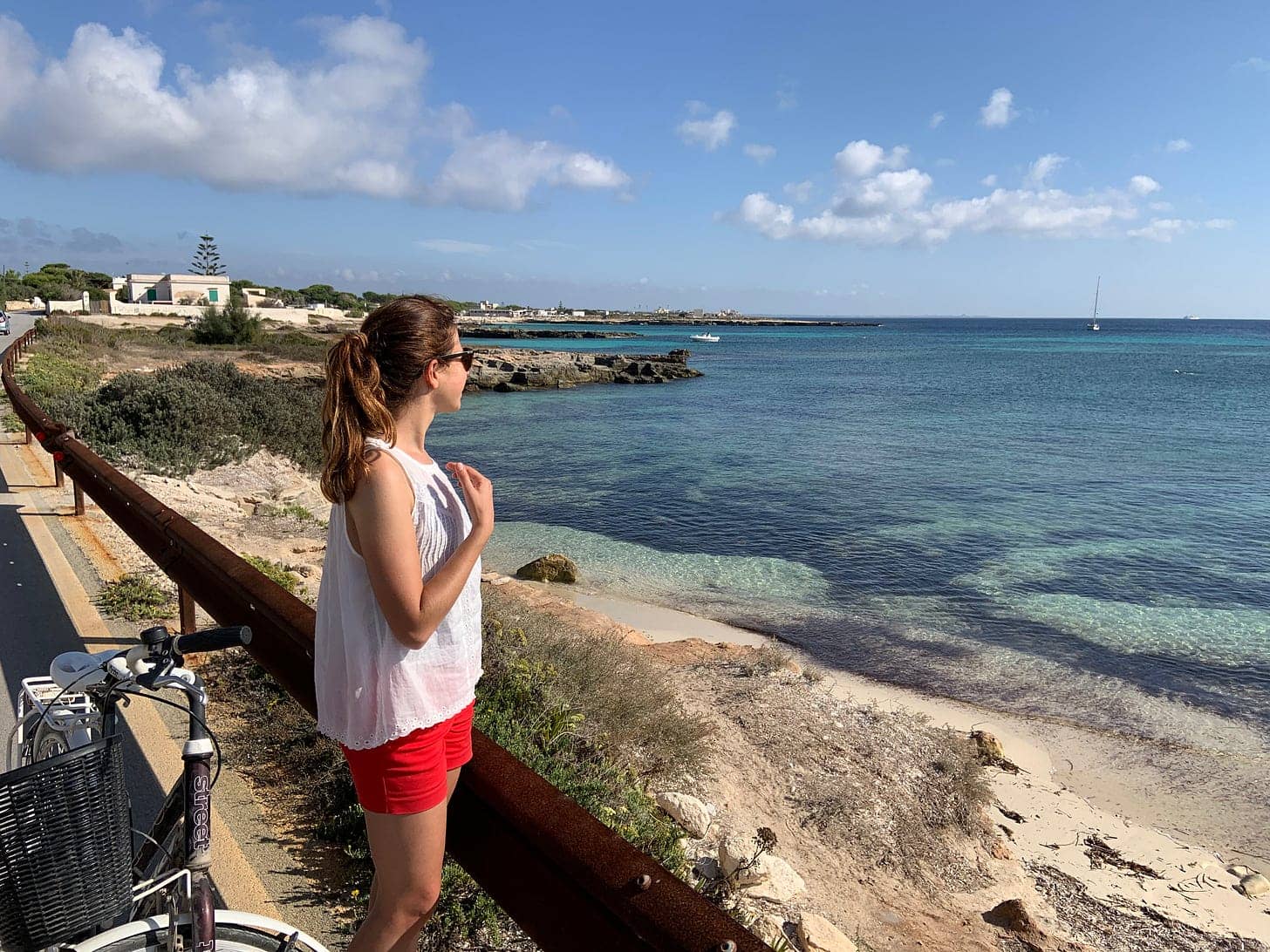
Cycling through a kind of white and ochre rocky desert, swimsuit still a little damp, a hat against the sun, and itching for a dip in the next cove. Lunch on cold caponata watching the waves, finished off with a caffè al pistacchio. Running the climb up the hill as a morning workout, and catching my breath with the wind blowing through what used to be a window of the Castle of Santa Caterina. That’s what my days on Favignana, the island off Trapani, were like a few years ago. That view, which I thought was mine, now belongs to Ulysses, and to movie theaters all over the world.
Some destinations work for years to get picked by a film: they set up film commissions, offer incentives, travel to international fairs to show off their locations. Favignana, as they tell it on the island, just got lucky. The largest of the Egadi Islands, half an hour away by ferry, is the Ithaca of Christopher Nolan’s The Odyssey. Ithaca exists, of course, and it’s in Greece, but anyone who wants to stand in the film’s Ithaca has to go to Sicily.
The prize for having been a film set is the famous economic spillover. But a production is not a development program. What happens next is up to the island.
The production spent a few months on the island, between late 2024 and spring 2025, to complete some seven weeks of shooting. It employed around 500 people, between extras and trades, and the mayor estimates between 1 and 2 million euros in local spending over those months. For using the old tonnara as base camp, he says, the town collected 130,000 euros. They built a cable car to haul equipment up to the castle and then took it down; the road the production asked for was never authorized.
What’s being announced is on another scale. 250 million euros in tourism over the next three years, or five, depending on who’s talking, and nobody signs off on it. At the town hall they say investors have come from North America, the Middle East and India, that an old holiday village is aiming for five stars, and that the Palazzotto Florio opens as a boutique hotel in June 2027. They’re celebrating, and they have reason to.
But Favignana is an island of coves. Cuts in the rock where you go straight into the water, jumping heroically off ledges or picking your way in water shoes over beds of stones. The most famous ones, like Cala Rossa, were quarries where for centuries, by hand and in blocks, they cut the stone that built the island and part of Trapani. At eleven in the morning, a cove is shared by the 3,000 residents, the people staying over, and those who got off the ferry that morning. On a summer day there are already between 40,000 and 50,000 people on the island.
Those who come, they say on the island, are mostly Italian, and half of them Sicilian. For someone from Trapani it’s their beach, half an hour away, and for many it’s the holiday they’ve always taken. For years, lodging was a matter of owners fixing up their homes as bed & breakfasts. Now businesspeople are arriving to take over the big properties.
The Italian press is alarmed by the White Lotus effect: groups marching on a pilgrimage to the photo spot, high prices, and the island turned into another Taormina. When that happens, the authorities look for protection, and there are two recipes: curb day trips and restrict short-term rentals. The town is already looking at Capri, which this summer capped groups at 40 people. But on Favignana the day visitor doesn’t always come in a group: it’s also the Sicilian crossing over from Trapani. And the short-term rentals belong to the people who own the houses. Off-the-shelf fixes rarely work. The island already has a rule of its own: in summer, if you’re staying fewer than six days, your car doesn’t come in. It stops the car, not the neighbor.
We can ask Sicilians how they picture their island after those five years of development and tourism. I’ll venture to describe the island I’d like to come back to. The sea is still for swimming. Local guides tell me the story of the castle and the tonnara, and take me to try cannoli filled on the spot, the way it should be. And while I read on a rock in the shade, I hear Sicilians shouting at each other before jumping in. A massage at the hotel spa in the afternoon, and then an aperitivo at the bar in town. Can an island grow, and protect itself, without pushing out the people who make it worth it?
White Lotus sold a life: the hotel, the breakfast, beautiful people ruining their vacations. That can be booked. Nolan sells a view. And Favignana’s view is at the end of a shadeless climb, or at the bottom of a jump off the rock. No van gets you there.
Maybe that’s enough. Maybe the stone will set the limit on its own, the hotels will come, and the guy from Trapani will keep crossing over on Saturdays. Maybe not, and Sicily will lose one of its detours. We don’t know. Not the mayor, not the investors, not the people who live there, not me.
Ulysses took ten years to get back to Ithaca. We’ll see what this one looks like a lot sooner.
Originally published in Sole Plazas on 8 October 2026.
In northern Argentina, August is celebrated by feeding the earth. In Italy, by closing the office.
In five days I received two messages.
The first came from the road that links Salta and Jujuy. A friend riding shotgun, telling me she was taking the day off to celebrate the first of August, as one should. I confess I had to google it.
The second arrived in writing, from a design studio in Alba, Piemonte. They were happy: the holidays are coming. Ferragosto is near.
In northern Argentina, as in other Andean regions, this is the dry season, so on the first of August a hole is dug in some corner of the garden, the balcony, the mountain, and the family offers the earth what it likes best: empanadas, wine, coca leaves, a fizzy drink. The earth is fed. Thanks are given, prosperity and fertility are asked for, and the empanadas and wine pass on to the guests. The siku, played in pairs because each musician holds half the notes, the chacareras, rock or cumbia sound in the background, and it all turns into a party.
In Italy, around these dates, the opposite happens. The 15th of August has been celebrated since Roman times. The tradition comes from the Feriae Augusti, the rest after the labours of the field decreed by the emperor, which later absorbed a Christian tradition, the Assumption of the Virgin. Over there it’s hot and everything is closed. If you’re in the city, you’re probably a foreigner. It’s not the earth that eats and drinks, but the Italians. Saying Buon Ferragosto is a way of closing the office, greeting the family and taking the train to leave the concrete behind.
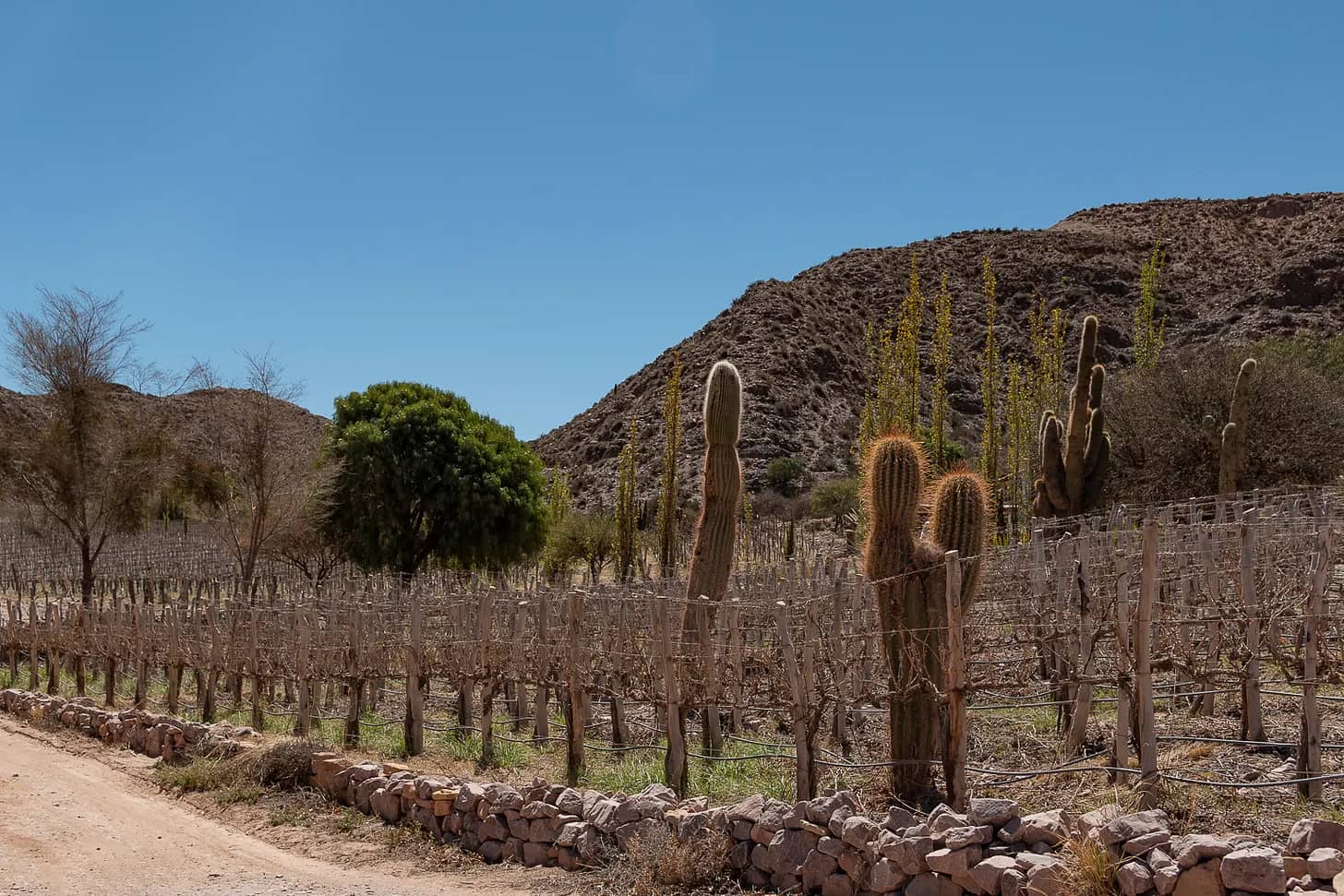
Something else is done in Argentina at this time of year, in the Litoral mostly, though it has spread a little to the rest of the country: drinking caña con ruda. Last Sunday was the first Vino de Viaje gathering, where we drank not caña but wine. One of the wines was from Jujuy, from the Quebrada de Humahuaca, a desert around the Río Grande. It’s hard to imagine vineyards there, among hills of seven and fourteen colours and cardón cacti several metres tall. But thirst suits the vine: less water, smaller bunches, each grape more concentrated. And the high-altitude radiation thickens its skin.
In Piemonte, between the Ligurian Sea and the Alps, the August heat has an expiry date: by October you can’t see the vineyard next door. That’s where Nebbiolo is harvested, a grape named after the fog and pale all the same: little colour, plenty of tannin.
The desert where you can see everything gives an opaque wine. The fog where you can see nothing gives a transparent one.
Besides the wine, I told them how to travel to each bottle: where the Dupont estate sits in Maimará, what you cross on the road, where to stop. And we talked about the pasacana, the cardón’s fruit, with those white hairs. I didn’t tell the legend: a cacique’s daughter who fled with a forbidden love, and Pachamama, who sheltered them by turning them into what they are now. She stayed there, embracing him, under the green poncho.
My friend has already toasted the earth and is driving back along that road. In Alba they’re closing the studio. The cardones are still there, standing in the desert.
Originally published in The Detour on 10 August 2026.
A cash-only ferry, an accidental detour, and a full-scale replica 8,000 kilometres away.
When I told my mother I was going to the Alps, she said not to miss Hallstatt. It was the place she had loved most on her trip fifteen years earlier. She warned me it wasn’t easy to get to, that she had gone with a tour. Stubborn as I am, I decided not to.
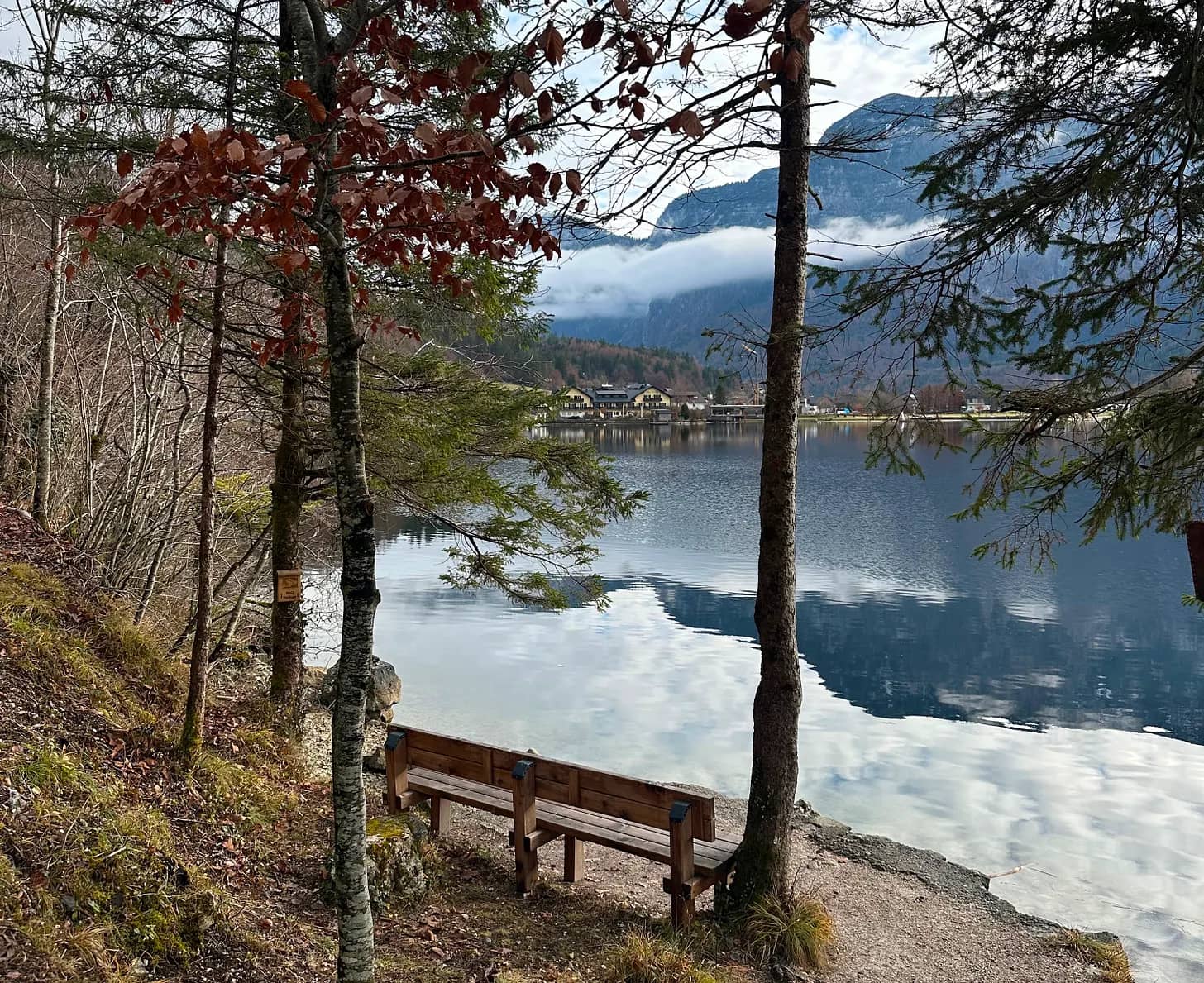
With the help of Google and AI, I optimised the perfect route from Salzburg. Hallstatt sits across a lake from its own train station, and you can reach it by road, driving straight in, or by a combination of transport. I chose the complicated one: a scenic bus skirting the great Wolfgangsee, a few stops on a local train and, finally, a short boat ride that crosses the Hallstätter See in a perfect straight line to arrive at the prettiest village in Austria, perhaps in all the Alps.
But the optimisation failed. As the crowd came off the train and began to pile up on the pier, I overheard, in someone else’s conversation, what was about to become my problem: only cash. And of course, I had none. With very little hope I waited for the boat to dock and asked about possible exceptions. The answer was a dry, simple no. I was stranded on the wrong side of the lake.
I looked along the left shore and spotted a path; according to the map, the next village was an hour away on foot. The alternative was to wait for another train, which would take just as long, or to turn back. It looked like a pleasant walk in the sun, so I set off along what seemed to be a bicycle path, rising and falling for a few kilometres beside the water.
When I reached Obertraun I found a village that was picturesque, but a ghost. From where the village began, with its little alpine houses and small uninhabited hotels, I walked another twenty minutes, starting to doubt a strategy that had brought me, on foot, to nowhere.
A few metres past the chapel stood the famous ATM. At the bus stop, a tidy timetable announced the next service in an hour. After a short, warm exchange with the woman at the tourism office, centred on the activities winter would soon bring with the snow, I went back out to wander until it was time. The absolute silence was broken by a bus returning children from school. While they got off and scattered, running to their houses, mine arrived.
Minutes later I was sitting with my nose against the glass to follow, up close, the route that climbed to the Krippenstein ski centre, on the Dachstein massif, and brought me, finally, to Hallstatt.
The first impression didn’t come from the village but from the number of people with suitcases, large and very large, moving in every direction. For me this was a day trip; it took me a while to understand what was happening. Since the detour had cost me more time than planned, I concentrated on getting lunch, though without much success: places were closed, or open but with no interest in having me. I managed, in the end, a soup opposite the Protestant church.
I walked the village end to end in far less time than the sunny path had taken me. I read the angry signs at the viewpoints: you may take the postcard photo, but in silence and without showing enthusiasm.
Of course. Hallstatt had lived through a boom, especially after the postcard materialised into a village replicated brick by brick by a mining company in Boluo, in Guangdong province.
The village exists because of salt. Its mine, one of the oldest in the world, was run by the Habsburgs from Vienna: hence the name of the region, Salzkammergut, the salt chest of the crown. Today it is an attraction with a slide. It was closed for renovation, like the giant balcony they built for taking photos over the See.
Until the late nineteenth century, Hallstatt could only be reached across the lake or along mountain paths. Now two roads arrive, one along each shore.
With no viewpoints available and the sun already dropping, I made a point of covering every street, the ones that climbed and had no shops, the ones far from the panoramic spots. Even so, the village ran out quickly.
I took the bus back to Obertraun. I wasn’t going to give the boat people the satisfaction.
After waiting in the silence of the station, I boarded the empty train. At the next stop, Hallstatt’s, everyone got on.
Do you have a town next door? One you reached by accident and liked better than the famous one. Leave its name in the comments: I’m collecting them for a future piece.
Originally published in The Detour on 14 July 2026.