
Switzerland at ease: trains, valleys and the elegance of a country that works without fanfare
slow logbook of panoramic trains, alpine villages and medieval fortresses. Beyond the clichés of watches and chocolate, Switzerland reveals its depth.
A nation of transitions
With four official languages and strong cantonal autonomy, there is no single Switzerland. Nor a single way to discover it. On this journey, we chose to avoid the big cities and focus on the south.
For two weeks we travelled on its famous trains: precise, elegant, silent. We added funiculars that climb mountains, cogwheel trains, and boats tracing routes along millenary shores. We discovered that Switzerland is understood through transitions: from one canton to another, from one language to the next, from snow to flowers, from silence to street fairs with live music. To understand Switzerland is to accept change as the rule, and contrast as its identity.
From Ticino to the line of glaciers
The route began near Lake Como, at the border between the canton of Ticino and the south of Graubünden, where we boarded the Bernina Express bound for St. Moritz.
The train climbs from Val Poschiavo, a green and Mediterranean region which, though fully Swiss, speaks Italian and lives at its own rhythm. Its agricultural terraces and gentle landscape contrast with the glacial world that opens up at altitude.

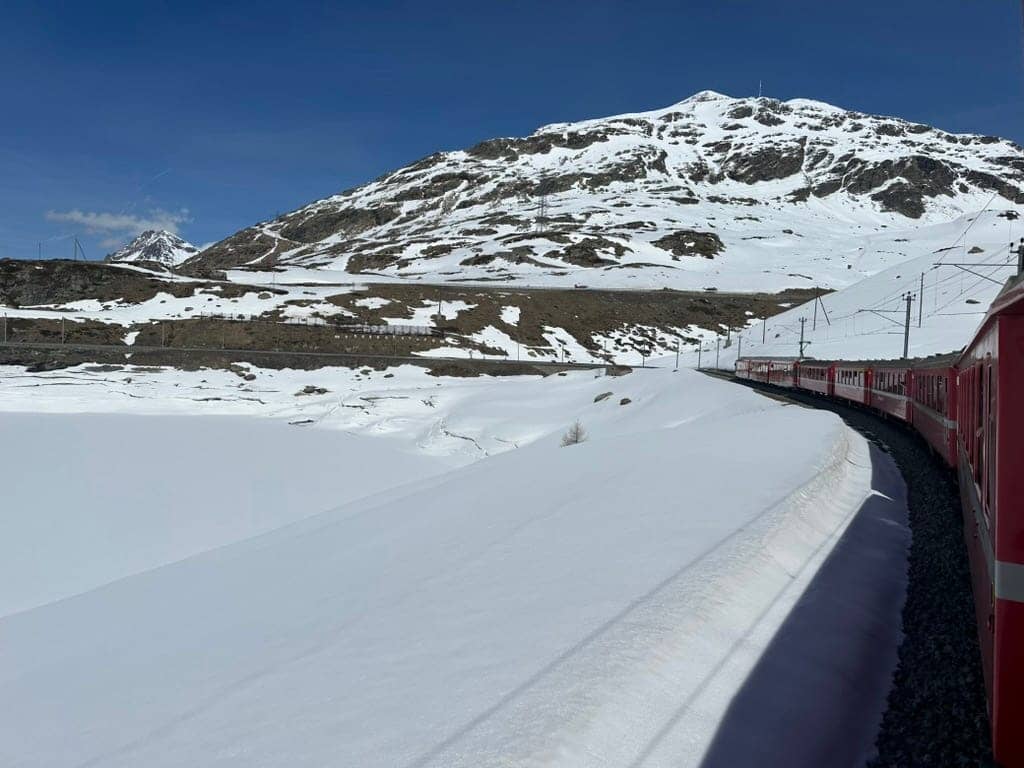
Crossing Ospizio Bernina (2,253 m) is not only the highest point of the route, but also a geographical threshold. Beside it, Lake Bianco—milky white from the minerals of the Palü glacier—contrasts with the darker Lake Nero, as if water itself spoke in different tones. Their colours tell a bifurcated story: the waters of the Bianco flow towards the Adriatic, while those of the Nero run to the Danube and the Black Sea. At this point, even the language shifts: we left Italian behind and entered the Romansh-speaking zone of Graubünden.
St. Moritz and luxury without belonging
In contrast with Italy, St. Moritz felt somewhat soulless. Perhaps because of the distance imposed by extreme luxury; perhaps because the snow season was ending. When belonging is measured through consumption, the place loses depth.
We preferred instead the image of the frozen lake yielding under the spring sun, and walking around it to see the mountains from every angle. It was a tactical pause: enough to observe without being absorbed.
The Glacier Express and history in motion
The following morning we boarded the Glacier Express, Switzerland’s most iconic train. For eight hours we did not simply cross the country: it was more than a journey, it was a display.
From the geometric void of the Rhine Gorge to the snow-covered Oberalp Pass where only the wind could be heard. In Disentis, the canton’s oldest monastery taught us that the word münster—familiar from Germany’s Black Forest—comes from the Latin monasterium: long before the Confederation there was life, frescoes, and onion-domed architecture.
In Trun the 14th-century peace treaty that gave birth to unified Switzerland was signed. In Andermatt, where trains, roads and tunnels converge, stands the Saint Gotthard Pass, the country’s backbone.
Every window of the train brought a new lesson: a typical dish (capuns), a 17-kilometre tunnel, an energy fact (60% of Swiss electricity comes from water, and nuclear plants will close in 2025). Each fact was not just information: it was part of the way Switzerland reveals itself. Everything had weight. Everything had form.
Zermatt: the alpine village par excellence
Arriving in Zermatt was entering another dimension. The Matterhorn, omnipresent, seemed to guard not only the Italian border, but also the skiers still enjoying a long season. Late snow had piled up more than five metres, a mantle that still descended the slopes.

We walked among ancient dark wooden houses with stone bases, not only in Zmutt but also in the village centre, where ancestral forms coexist with the technical sophistication of the present.
On the hikes towards Furi we passed through two hamlets where we learned that these 15th-century structures—mountain shelters for shepherds and peasants—were raised on pillars with round stones designed to block rodents. Their larch walls, blackened by time, remain firm; their stone-slab roofs protect the buildings through centuries.
A small museum on high-altitude farming taught us about rye, transhumance and the harsh life of those who lived here long before tourism. Switzerland was not always wealthy: it was, first, resilient.
The transport systems to the summits are feats of engineering that operate with almost invisible elegance. The modern, silent Matterhorn Glacier Paradise cableway took us up to 3,883 metres: the highest point in Europe accessible without climbing. From there, with temperatures below zero, we looked over more than thirty 4,000-metre peaks and fourteen glaciers stretching across Switzerland, Italy and France.
By contrast, the old cogwheel train to Gornergrat carried us to 3,089 metres. The view opened to new peaks and other faces of the Matterhorn. We had planned to stay two hours but spent the entire day. Not only for the imposing presence of the Matterhorn, but for the amphitheatre of glaciers unfolding around it.
Accumulated snow blocked the planned trails, but revealed another way of seeing the mountain: the silence of the Gorner glacier, extended like a tongue that cracked and groaned as it descended, demanded pause. We picnicked on a bench among the ice, while alpine choughs tried to steal our lunch. We listened to the wind filtering between the peaks: a silence that was not absence, but the full presence of place.
We also visited the mountaineers’ cemetery, where the dates of the first expeditions spoke of risk, skill and will. Fascinatingly, we learned that while the Swiss side has permanent life, the Italian side has no settlements, though it hosts a dense network of slopes, refuges and high-altitude restaurants. A mountain “empty” of villages is, in fact, intensely lived through sport.
We shared a local soup with skiers arriving from the other side. Advertised in German as “grandmother’s soup”, it was more than food: it was a meeting point, a shared gesture in a landscape crossed on skis or boots.
Vaud and the Swiss Riviera
From there we packed to cross into the canton of Vaud. It was more than a language change. Everything softened: the Lavaux terraces, paths lined with wildflowers—and others meticulously planted—, boats anchored before Art Nouveau villages.
In Les Avants we looked for daffodils; in Clarens we descended on foot through lime trees; and on Lake Geneva we sailed on a Belle Époque steamboat still propelled by its original oil machinery, like a floating museum. Glasses of local wine served in deckchairs on the upper deck made the journey unforgettable.
Montreux surprised us with its floral display. Tulips of every shape and colour, arranged with almost curatorial aesthetics, turned the lake promenade into a moving garden. Running there at dawn was revealing: I saw bulbs being changed, new aromas rising from aromatic beds, spring organised with method and care.
Higher up, on the slopes, we saw what the late snow had hidden in Zermatt: transhumance. Sheep and cows with bells ascending to fresh pastures marked the season with ancestral precision.

Lavaux was perhaps the perfect summary of Swiss contrast: vineyards cultivated for centuries where 98% of the wine is consumed domestically. A local jewel thriving thanks to three suns: the one in the sky, the reflection from the lake, and the heat the terraces’ stones release at dusk.
Everything seemed to obey a secret logic: the logic of care.

Borders, fortresses and the art of passage
Before becoming a tourist destination, Switzerland was a passage: a geography to cross, but also to defend. We visited castles such as Chillon, on Lake Geneva, and those of Bellinzona, whose fortified trio—Castelgrande, Montebello and Sasso Corbaro—speaks of a time when borders were not abstract lines but points of watch, toll and shelter.
In Bellinzona, their strategic arrangement follows a logic of surveillance dating back to Roman times, perfected in the 15th century by the Dukes of Milan—first the Visconti, then the Sforza.
Further west, Chillon Castle controlled traffic along the narrow path skirting cliffs between Vaud and Valais. It is no coincidence that nearby lies the Saint-Maurice Pass, a historic gateway to the upper Rhône Valley.

These fortresses remind us that the Alps are not only a natural barrier but also a network of strategic corridors. Switzerland is a land of passes: Gotthard, Bernina, Simplon, Oberalp. Paths once used by people, armies and goods—sometimes slowly, sometimes stealthily, sometimes with warrior spirit.
Today, where customs stood, there are platforms. Where there was control, there is crossing.
Lugano and Locarno: the south also exists
Back in Italian-speaking Switzerland, Lugano reminded us that the south also exists. We walked its main avenue, among elegant shops and noble façades, down to Parco Ciani, where benches face the water with serenity. We rented a boat and crossed beyond the Italian border: an unmarked frontier, visible in the tones of houses, the shape of hills, the music in the background.
We ended in Locarno, between a food-truck fair in Piazza Grande and the solemnity of the Santuario della Madonna del Sasso. Built after friar Bartolomeo Piatti claimed to see the Virgin on the rock in 1480, the sanctuary rises above a town that today combines baroque masses above with street food below. That simultaneity—between the elevated and the earthly, the Swiss and the Italian, the precise and the lived—was perhaps the best synthesis of the trip.
Valle Verzasca: a Switzerland without showcases
We closed the journey in Valle Verzasca, built around the emerald river that gives it its name. Its stone villages are spanned by the Ponte dei Salti, a medieval two-arched bridge at Lavertezzo that seems drawn from a tale.

On the hike to Sonogno waterfall we encountered sculptures carved in tree trunks: part of an artistic trail linking nature, culture and contemporary art with deep respect for the alpine surroundings. A more authentic farewell. More rural. A Switzerland without showcases.
Travelling through Switzerland is not following a straight line. It is accepting that countries are also narrated in layers: by trains, yes, but also by valleys; by impeccable infrastructure, from a punctual bus to a funicular floating among peaks; and by the way everything integrates into the rhythm of landscape.
Switzerland does not impose itself: it works with precision, but it is felt with wonder.
If this read made you want to travel at a slower pace—or to look differently at the world you already know—share it with someone who also appreciates slow rhythms, good trains and stories told in layers.
My itineraries are designed for that: to make you feel, be amazed, learn, and return with memories that cannot be bought.
If you are dreaming of your next journey, write to me.
Want to receive my newsletter? Subscribe to "El Baùl Cultural" on my Substack!
A weekly space for reflection where I share my experiences, expressed through my passions: reading, travel, film, art, politics, and technology.
In northern Argentina, August is celebrated by feeding the earth. In Italy, by closing the office.
In five days I received two messages.
The first came from the road that links Salta and Jujuy. A friend riding shotgun, telling me she was taking the day off to celebrate the first of August, as one should. I confess I had to google it.
The second arrived in writing, from a design studio in Alba, Piemonte. They were happy: the holidays are coming. Ferragosto is near.
In northern Argentina, as in other Andean regions, this is the dry season, so on the first of August a hole is dug in some corner of the garden, the balcony, the mountain, and the family offers the earth what it likes best: empanadas, wine, coca leaves, a fizzy drink. The earth is fed. Thanks are given, prosperity and fertility are asked for, and the empanadas and wine pass on to the guests. The siku, played in pairs because each musician holds half the notes, the chacareras, rock or cumbia sound in the background, and it all turns into a party.
In Italy, around these dates, the opposite happens. The 15th of August has been celebrated since Roman times. The tradition comes from the Feriae Augusti, the rest after the labours of the field decreed by the emperor, which later absorbed a Christian tradition, the Assumption of the Virgin. Over there it’s hot and everything is closed. If you’re in the city, you’re probably a foreigner. It’s not the earth that eats and drinks, but the Italians. Saying Buon Ferragosto is a way of closing the office, greeting the family and taking the train to leave the concrete behind.
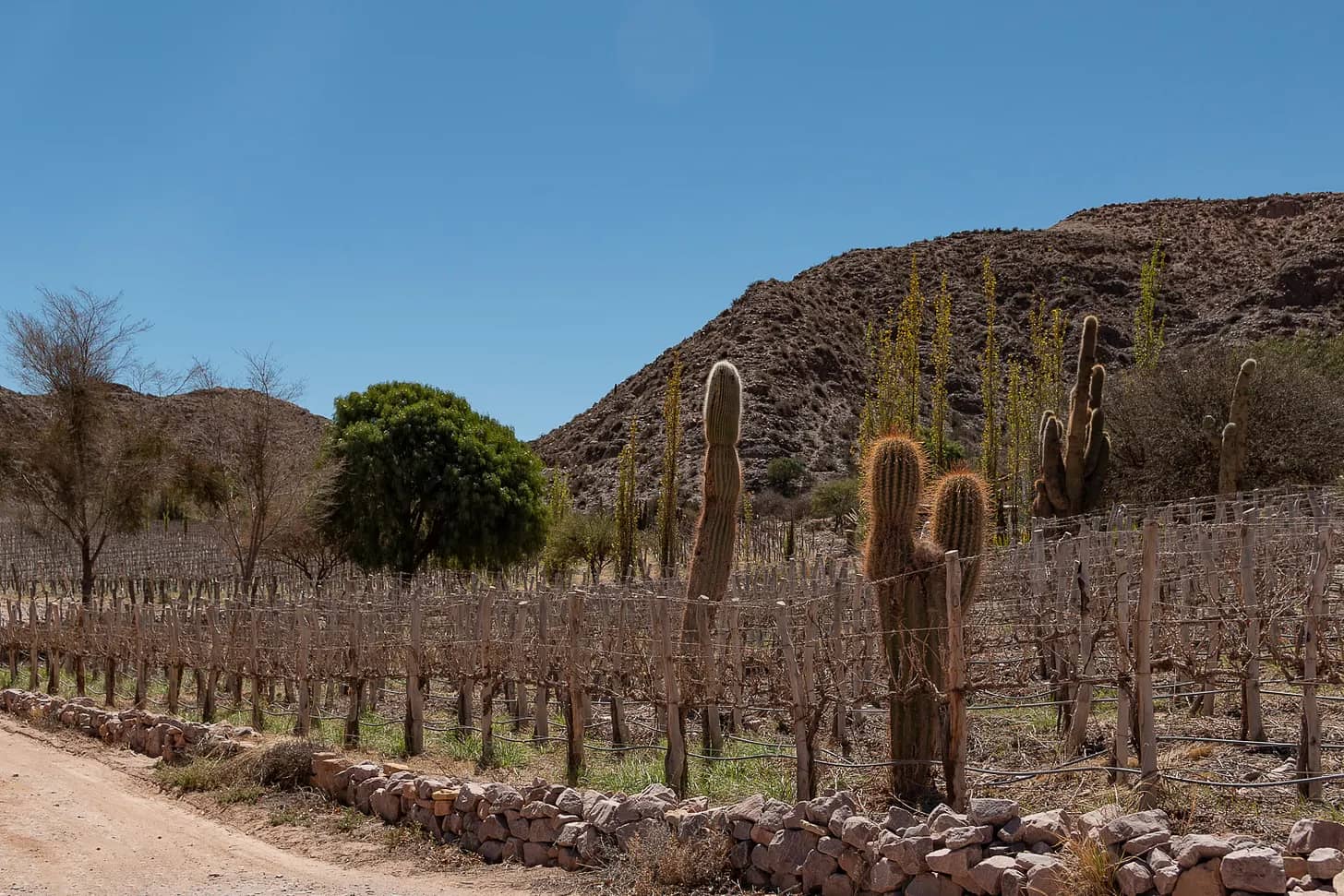
Something else is done in Argentina at this time of year, in the Litoral mostly, though it has spread a little to the rest of the country: drinking caña con ruda. Last Sunday was the first Vino de Viaje gathering, where we drank not caña but wine. One of the wines was from Jujuy, from the Quebrada de Humahuaca, a desert around the Río Grande. It’s hard to imagine vineyards there, among hills of seven and fourteen colours and cardón cacti several metres tall. But thirst suits the vine: less water, smaller bunches, each grape more concentrated. And the high-altitude radiation thickens its skin.
In Piemonte, between the Ligurian Sea and the Alps, the August heat has an expiry date: by October you can’t see the vineyard next door. That’s where Nebbiolo is harvested, a grape named after the fog and pale all the same: little colour, plenty of tannin.
The desert where you can see everything gives an opaque wine. The fog where you can see nothing gives a transparent one.
Besides the wine, I told them how to travel to each bottle: where the Dupont estate sits in Maimará, what you cross on the road, where to stop. And we talked about the pasacana, the cardón’s fruit, with those white hairs. I didn’t tell the legend: a cacique’s daughter who fled with a forbidden love, and Pachamama, who sheltered them by turning them into what they are now. She stayed there, embracing him, under the green poncho.
My friend has already toasted the earth and is driving back along that road. In Alba they’re closing the studio. The cardones are still there, standing in the desert.
Originally published in The Detour on 10 August 2026.
A cash-only ferry, an accidental detour, and a full-scale replica 8,000 kilometres away.
When I told my mother I was going to the Alps, she said not to miss Hallstatt. It was the place she had loved most on her trip fifteen years earlier. She warned me it wasn’t easy to get to, that she had gone with a tour. Stubborn as I am, I decided not to.
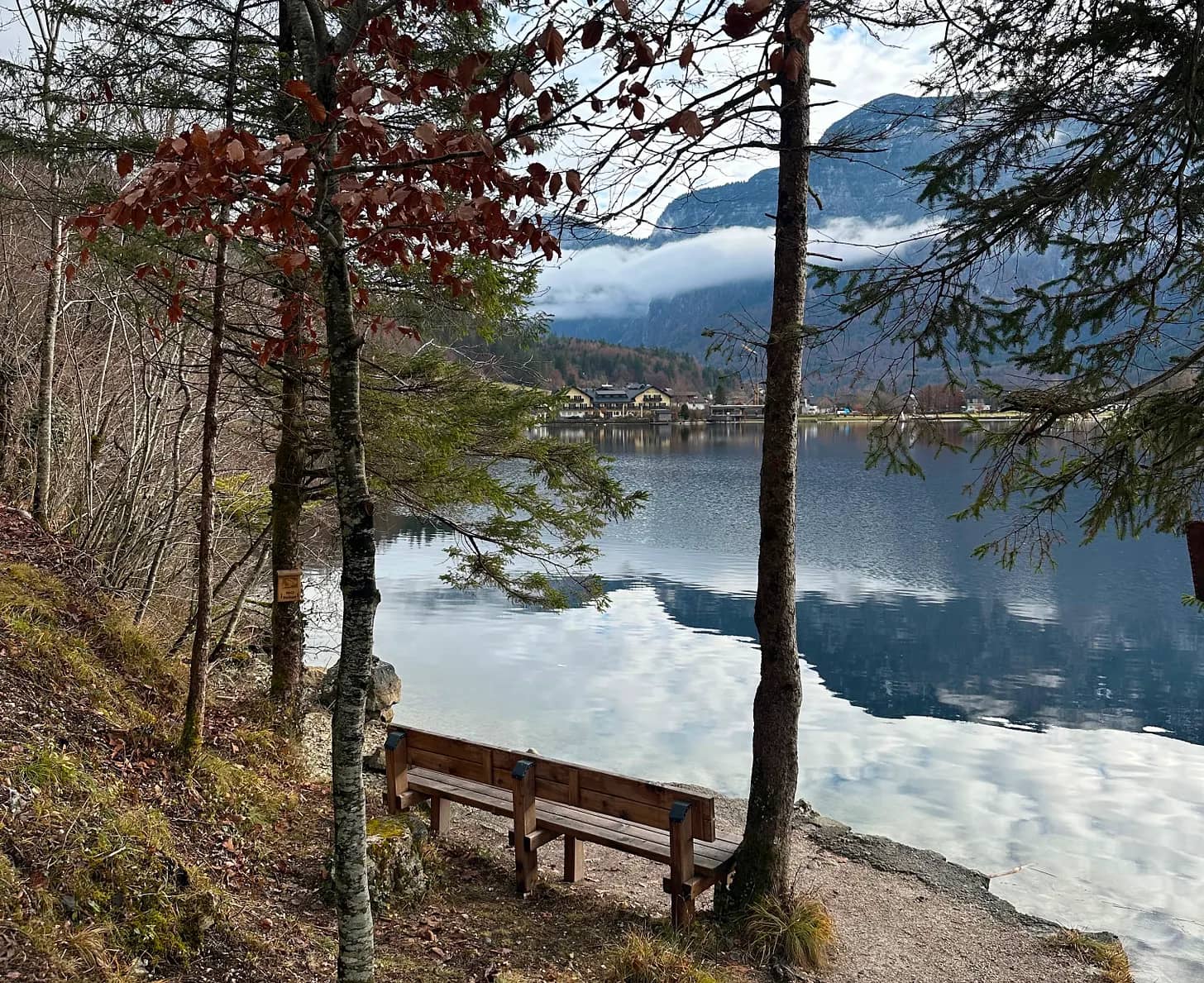
With the help of Google and AI, I optimised the perfect route from Salzburg. Hallstatt sits across a lake from its own train station, and you can reach it by road, driving straight in, or by a combination of transport. I chose the complicated one: a scenic bus skirting the great Wolfgangsee, a few stops on a local train and, finally, a short boat ride that crosses the Hallstätter See in a perfect straight line to arrive at the prettiest village in Austria, perhaps in all the Alps.
But the optimisation failed. As the crowd came off the train and began to pile up on the pier, I overheard, in someone else’s conversation, what was about to become my problem: only cash. And of course, I had none. With very little hope I waited for the boat to dock and asked about possible exceptions. The answer was a dry, simple no. I was stranded on the wrong side of the lake.
I looked along the left shore and spotted a path; according to the map, the next village was an hour away on foot. The alternative was to wait for another train, which would take just as long, or to turn back. It looked like a pleasant walk in the sun, so I set off along what seemed to be a bicycle path, rising and falling for a few kilometres beside the water.
When I reached Obertraun I found a village that was picturesque, but a ghost. From where the village began, with its little alpine houses and small uninhabited hotels, I walked another twenty minutes, starting to doubt a strategy that had brought me, on foot, to nowhere.
A few metres past the chapel stood the famous ATM. At the bus stop, a tidy timetable announced the next service in an hour. After a short, warm exchange with the woman at the tourism office, centred on the activities winter would soon bring with the snow, I went back out to wander until it was time. The absolute silence was broken by a bus returning children from school. While they got off and scattered, running to their houses, mine arrived.
Minutes later I was sitting with my nose against the glass to follow, up close, the route that climbed to the Krippenstein ski centre, on the Dachstein massif, and brought me, finally, to Hallstatt.
The first impression didn’t come from the village but from the number of people with suitcases, large and very large, moving in every direction. For me this was a day trip; it took me a while to understand what was happening. Since the detour had cost me more time than planned, I concentrated on getting lunch, though without much success: places were closed, or open but with no interest in having me. I managed, in the end, a soup opposite the Protestant church.
I walked the village end to end in far less time than the sunny path had taken me. I read the angry signs at the viewpoints: you may take the postcard photo, but in silence and without showing enthusiasm.
Of course. Hallstatt had lived through a boom, especially after the postcard materialised into a village replicated brick by brick by a mining company in Boluo, in Guangdong province.
The village exists because of salt. Its mine, one of the oldest in the world, was run by the Habsburgs from Vienna: hence the name of the region, Salzkammergut, the salt chest of the crown. Today it is an attraction with a slide. It was closed for renovation, like the giant balcony they built for taking photos over the See.
Until the late nineteenth century, Hallstatt could only be reached across the lake or along mountain paths. Now two roads arrive, one along each shore.
With no viewpoints available and the sun already dropping, I made a point of covering every street, the ones that climbed and had no shops, the ones far from the panoramic spots. Even so, the village ran out quickly.
I took the bus back to Obertraun. I wasn’t going to give the boat people the satisfaction.
After waiting in the silence of the station, I boarded the empty train. At the next stop, Hallstatt’s, everyone got on.
Do you have a town next door? One you reached by accident and liked better than the famous one. Leave its name in the comments: I’m collecting them for a future piece.
Originally published in The Detour on 14 July 2026.
Four Sicilian beaches, and the best one isn’t the famous one.
The most useful warnings before a trip don’t come from guidebooks — they come from people who make a living receiving travellers. I learnt this working with hosts at Airbnb. Before my first trip to Sicily, a mendocina with Sicilian roots warned me: “To travel through Sicily, plan your trip around the colour of the sea and the sand, depending on what you like.” These are four I tried.
Vendicari
When I do road trips, I like to look at the map for places to add as intermediate stops. That’s how Vendicari appeared, on the way down from Noto towards the coast. A nature reserve where there were once tonnare; today, occasional flamingos and travellers chasing the promise of Caribbean sand. To reach Calamosche you walk a slightly arid trail, watching birds along the way. I don’t know whether it was the heat, the sun, or the intensity of a Sicilian autumn that still feels like summer, but after walking forty minutes under the sun towards the famous turquoise, I liked it, but I didn’t find myself there.
Isola Bella
Taormina is one of Sicily’s jewels: its Greek theatre, its views that feel like a balcony over Etna, its elegant streets, and lately, the fame of White Lotus. Parking the car was a challenge I wouldn’t wish on anyone: streets with impossibly steep gradients, a tiny car park, and a crowd that overwhelms. It felt a little like stepping out of the Sicily I’d been living in. After wandering and walking up to the next village, I decided to visit Isola Bella. The cable car connecting the historic centre to the Mazzarò coast was closed — I think because of strong winds. Luckily, the heat at Calamosche had already trained me to walk in high temperatures, and going down is always easier than going up. The view is the beautiful postcard we all know. But I didn’t stay for the day: the shallow water, the jellyfish, the crowds. Obligatory photo, and I left. Not my cup of tea.
These days, the most photographed beach of a place and the best beach of a place are almost never the same.
Giardini Naxos
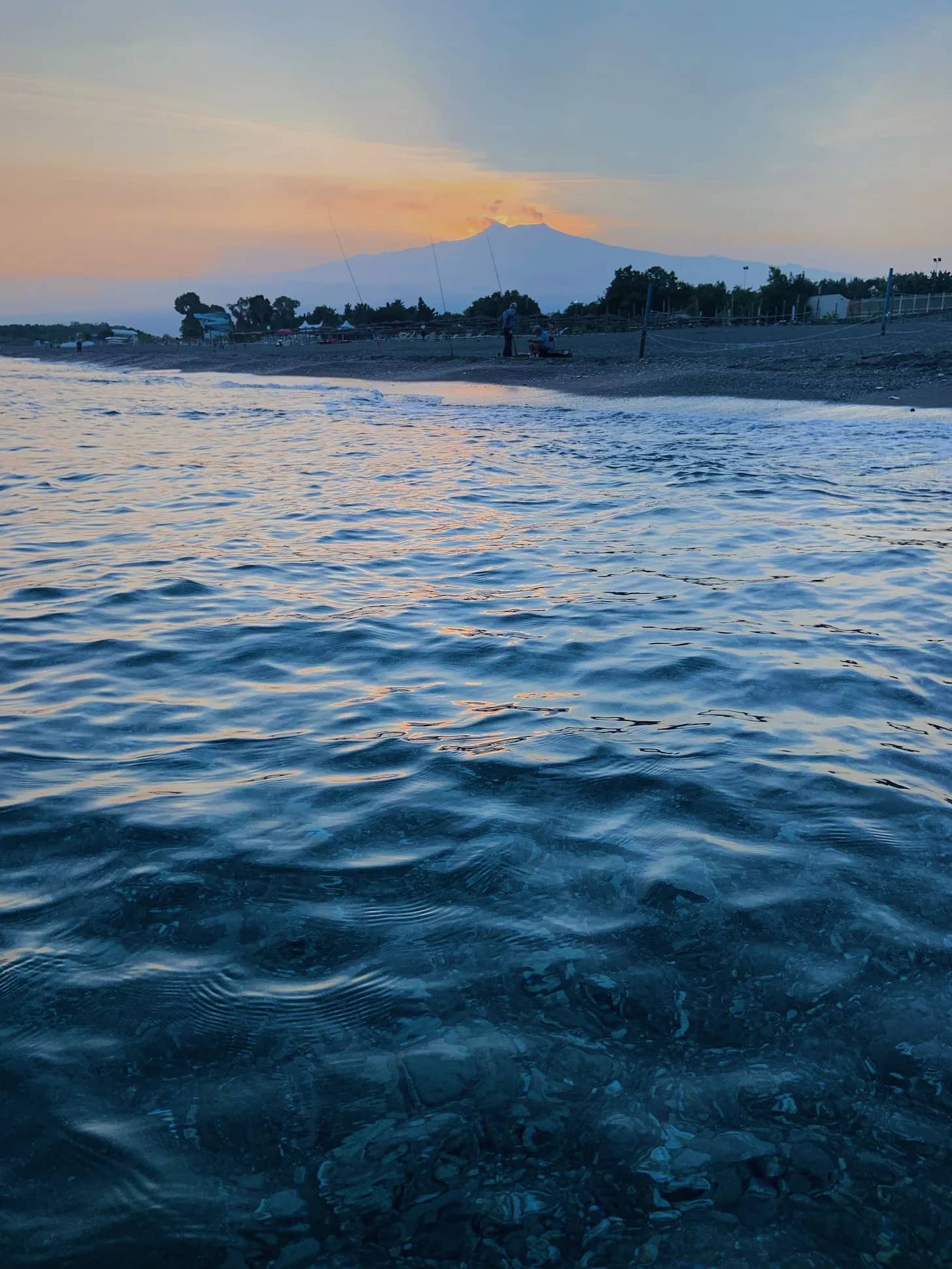
I rented the flat of the mendocina host, the same one from the warning, and let myself stay somewhere off the circuit, at the foot of Taormina. It isn’t a magazine destination. Walking towards the fishmonger waiting with i ricci, the signs spoke to me in Italian and in Cyrillic; the Russians discovered this stretch of coast decades ago, before fashion looked this way. I gained breakfasts and dinners listening to the waves. The beach is long, of black sand: the same sand you slide down running when you trek up Etna. Going out for a jog in the morning and slipping into the sea on the way back. A sea that drops off quickly, only a few steps before you can swim. Fish passing by, the water a deep blue — not the turquoise of postcards but something deeper, transparent all the same — and Etna erupting in the distance.
Etna erupts almost always, and watching it with its explosions while floating on a beach made of its own sand wasn’t a tourist curiosity, but learning what Sicilians have known for centuries: that you can live close.
Favignana
It isn’t quite Sicily. It’s an island apart, off the west coast, an hour by ferry from Trapani. And unlike the others, it isn’t a place to arrive at but to wander through: by bike or by golf cart, from one cove to another, jumping off the rocks into transparent water, going back the next day to the one you liked best. If you’ve travelled European beaches, you probably own a pair of water shoes; mine came from a stall at the port. A detour within the detour.
What would your beach be? The one at the end of the hot trail, the postcard one, the one by Etna, or the ones in Favignana by bike? It says more about you than about Sicily.
Originally published in The Detour on 27 May 2026.